A U.S. stock stops trading when Wall Street closes.
A tokenized version of that stock does not have to.
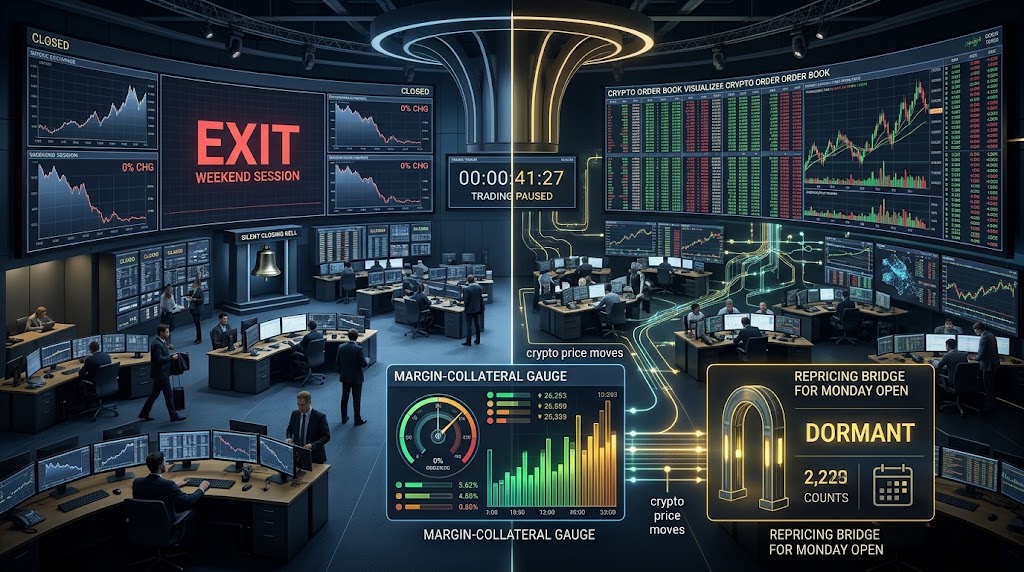
Starting October 24 at 00:00 UTC, Binance will update the collateral index prices of eligible bStocks continuously through weekends, holidays and other periods when the underlying U.S. equity market is closed.
During those closed periods, Binance will stop freezing the collateral reference near the last traditional-market price and instead derive it from its own bStocks order books using an exponentially weighted moving average.
That solves one pricing mismatch and creates another risk users need to understand: a stock-token price formed entirely inside the crypto venue can now change the value of collateral backing a leveraged account while the underlying share cannot trade.
The Old System Froze the Collateral Reference
bStocks trade around the clock, but the underlying U.S. securities do not.
Until this change, the collateral index used during closed-market periods could remain anchored to the most recent valid U.S. equity-market price.
That created a strange situation. The token could keep trading higher or lower on Binance, but the amount of collateral credit assigned to it could remain comparatively static until the traditional market reopened.
The October 24 methodology makes the collateral value move with the crypto-market version of the asset instead.
The New Price Comes From Binance’s Own Order Book
When U.S. equity-market data is unavailable, Binance says the index will use an Orderbook EWMA mode.
The mechanism begins with an impact mid price from the Binance order book and smooths it through an exponentially weighted moving average.
Binance also applies a dedicated movement cap during these periods and blends the index gradually when it transitions back to a mode using traditional-market prices.
The exact cap is not fixed publicly in the announcement and can be adjusted by Binance.
That is a sensible anti-manipulation control, but it also means the collateral model is partly a venue-defined risk system rather than a mirror of the underlying stock exchange.
A Falling Weekend Price Can Now Push a Margin Account Toward Liquidation
The most important sentence in Binance’s updated methodology is operational rather than technical.
Collateral value will now update dynamically 24/7, so a user’s Margin Level or Unified Maintenance Margin Ratio can change during non-trading hours.
A lower bStock collateral value reduces the cushion protecting borrowed positions. If the overall account breaches its liquidation threshold, normal margin-liquidation rules can apply.
The new pricing system does not itself force liquidation every time a token moves. It changes one of the numbers that determines whether the account reaches the liquidation line.
That distinction matters because ‘tokenized stock moved on Sunday’ becomes economically meaningful even though the underlying company share cannot yet print a Sunday price on Nasdaq or NYSE.
Tokenized Stocks Can Trade Away From the Underlying
Binance explicitly warns that a bStock can trade at a premium or discount to the underlying security.
Off-hours liquidity, inventory, market-maker risk, news events and crypto-market demand can all move the tokenized market away from the last official equity close.
Optimisus recently covered the structural difference between price exposure and actual securities rights in Securitize Put Actual Shareholder Rights on Solana, and the market-design problem in OKX and ICE Built a Permissioned Uniswap Pool for Real U.S. Stocks.
The Binance collateral change adds another layer: even where a token is backed by a security, the secondary-market price used for leverage can have its own microstructure.
This Is the Price of Making a 9:30-to-4 Asset Work Inside a 24/7 Margin System
Crypto margin systems are built around collateral that trades continuously.
Equities are not.
Freezing the stock price while crypto positions move creates stale collateral. Updating the tokenized price through the weekend creates a price that may be less connected to the traditional market.
There is no perfect solution because the clocks are different.
Optimisus has already documented the broader demand for around-the-clock stock exposure in Perpetual Futures on U.S. Stocks Did $445 Billion on One Crypto Exchange in a Month. The collateral system is now catching up to the trading behavior.
The Monday Reopen Is the Second Risk Event
Binance’s methodology also warns that the traditional market can reopen at a significantly different level after a weekend or holiday.
That creates two separate repricing moments.
First, the collateral index moves based on Binance’s own trading while Wall Street is closed. Then, when the underlying market reopens, the reference transitions back toward external equity-market pricing.
Binance uses a weighted blend to reduce sudden jumps, but it cannot remove genuine differences between the off-hours tokenized market and the reopening stock market.
For users treating tokenized equities as margin collateral, the practical lesson is that the underlying company may sleep for the weekend. The collateral account no longer does.
This is not financial advice.
Sources
- Binance – 24/7 dynamic updates for bStocks collateral index prices – Primary announcement of the October 24 change.
- Binance – bStocks Tokenized Securities Collateral Index Price Methodology – Primary methodology covering Orderbook EWMA, transition blending and margin-risk effects.
- Binance – bStocks Margin Collateral Risk Controls Guide – Primary explanation of account restrictions and the separate liquidation threshold.