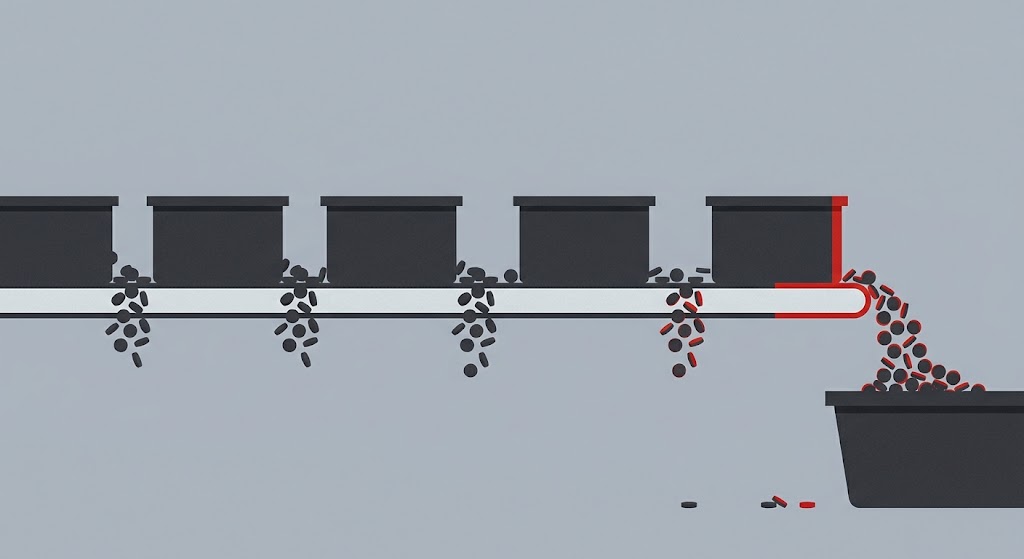
Realized hashrate across a cohort of public bitcoin miners fell from 368.3 exahashes per second in the fourth quarter of 2025 to 319 in the second quarter of 2026.
That is a 13.4% cut in six months. Over the same period the bitcoin network’s average hashrate fell 10.6%.
Listed miners are contracting faster than the network they are supposed to secure.
The Number That Actually Tells the Story
One company distorts the average.
Bitdeer grew its realized hashrate 44% to 63 EH/s while everyone else shrank. Strip Bitdeer out and the remaining cohort fell 21.2%, from 324.6 EH/s to 255.9 EH/s.
So the headline 13.4% understates what most operators did. A fifth of the listed sector’s mining capacity came offline in half a year.
The BlocksBridge Consulting data, published in its Miner Weekly newsletter, tracks quarterly steps of 368.3, then 344.4, then 319 EH/s. The network’s own quarterly average went 1,071, then 993, then 957 EH/s.
| Measure | Q4 2025 | Q2 2026 | Change |
| Public miner cohort | 368.3 EH/s | 319 EH/s | down 13.4% |
| Cohort excluding Bitdeer | 324.6 EH/s | 255.9 EH/s | down 21.2% |
| Bitdeer alone | n/a | 63 EH/s | up 44% |
| Bitcoin network average | 1,071 EH/s | 957 EH/s | down 10.6% |
Where the Power Went
Two companies show the transition most clearly in their revenue mix.
Core Scientific reported $136.7 million in colocation revenue for the second quarter against $27.5 million from bitcoin mining. Colocation is now roughly five times the size of the mining business.
TeraWulf posted $31.9 million in high-performance computing lease revenue against $12.8 million from mining.
For both, mining is no longer the main business. It is the legacy business.
The Sector Has Split, Not Pivoted
This is the part most coverage flattens, and it matters.
Riot Platforms reported $23.2 million in data center revenue against $113.7 million from mining. Bitdeer generated $14 million from AI cloud services against $197.1 million from mining-related activities.
Hut 8 and MARA reported smaller compute contributions. Cipher and Keel Infrastructure had yet to recognize any HPC revenue.
So there is no industry-wide exit from mining. There is a widening gap between companies that have completed the conversion and companies still funding themselves on hashrate.
That split explains why the cohort average is misleading in both directions.
Why the Economics Point This Way
Mining profitability weakened after the most recent halving. Block rewards halve on a fixed schedule while electricity costs do not.
AI infrastructure demand has run in the opposite direction since 2022. Miners already own the two things AI data centers are short of: contracted power at scale and the electrical build-out to use it.
The revenue quality is also different. Colocation and HPC leases are recurring contracted income. Mining revenue is a function of hashprice, which nobody controls.
Optimisus covered the early version of this thesis when VanEck projected miners could unlock $38 billion by shifting 20% of operations to AI, and when Core Scientific signed a $3.5 billion deal with CoreWeave.
What was a projection two years ago is now visible in quarterly filings.
What It Means for Bitcoin Itself
Falling hashrate is not automatically bearish for the network. Difficulty adjusts, and remaining miners earn a larger share of the same rewards.
The security argument is more nuanced than the headline suggests. Hashrate leaving publicly traded, regulated, US-listed operators does not mean it leaves the network permanently, but it does shift where it sits.
The more immediate market effect runs through selling pressure. Miners funding an expensive infrastructure conversion have a reason to sell coins, and Optimisus has documented that behavior at scale, including MARA’s first-half sales and its pivot to borrowing against the rest.
The Risk in the Trade
AI infrastructure demand is being priced as though it compounds indefinitely. It might not.
Cerebras jumped more than 11% intraday this week before falling over 16% after hours on its earnings release, which is a reminder that AI infrastructure names are being held to earnings validation rather than narrative.
Miners converting to colocation are taking on long-lived capital commitments against demand from a small number of very large customers. That is a different risk profile from hashprice exposure, not obviously a smaller one.
The next phase depends on whether non-mining expansion keeps outpacing the mining revenue it replaces. For Core Scientific and TeraWulf it already has. For most of the cohort, the answer is still unresolved.
The Practical Read
If you hold miner equities as leveraged bitcoin exposure, that thesis is expiring at different speeds across the sector.
Core Scientific and TeraWulf are now infrastructure companies with a mining segment. Riot and Bitdeer are still mining companies with a data center segment. Those should not trade on the same logic, and increasingly they do not.
The BlocksBridge cohort figure is a useful headline. The company-level revenue split is the number that tells you what you actually own.
Sources
- Cointelegraph, Bitcoin mining capacity shifts as AI data center demand grows — https://cointelegraph.com/news/bitcoin-miners-hashrate-ai-data-centers-hpc
- Miner Weekly, Public miners shed 21% of bitcoin hashrate as AI revenue accelerates — https://www.minerweekly.com/p/public-miners-shed-21-of-bitcoin
- Bitbo, Public miners cut hashrate 13.4% as AI revenue takes over — https://bitbo.io/news/public-miners-cut-hashrate-ai-revenue/
- GNcrypto, Public bitcoin miners cut realized hashrate 13.4% amid AI revenue — https://www.gncrypto.news/news/public-bitcoin-miners-cut-realized-hashrate-13-4-ai-revenue/
- KuCoin, Bitcoin miners’ hashrate drops 13.4% as AI infrastructure revenue rises — https://www.kucoin.com/news/flash/bitcoin-miners-hashrate-drops-13-4-as-ai-infrastructure-revenue-rises
- KuCoin, Crypto daily market report, August 13, 2026 — https://www.kucoin.com/news/articles/crypto-daily-market-report-august-13-2026
This is not financial advice.
Optimisus covers crypto and technology news for readers who want the detail behind the headline.