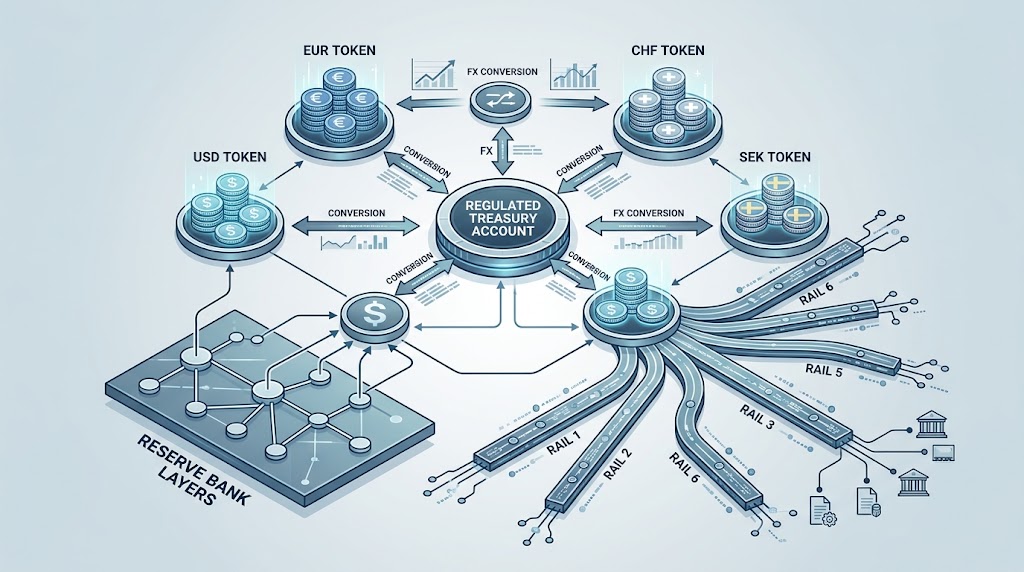
The European Central Bank launched Pontes on September 21, giving banks and market infrastructures a way to settle tokenized-asset transactions in central-bank money.
That distinction is the entire story. Tokenization has not struggled to create digital assets. It has struggled to agree on what money should sit on the other side of the trade.
Crypto markets usually solve that problem with stablecoins. Traditional securities markets prefer commercial-bank deposits or central-bank reserves. Pontes gives tokenized finance a bridge to the safest settlement asset in the euro system without requiring institutions to settle a bond or fund against a private digital currency.
Pontes Is Wholesale Infrastructure, Not the Retail Digital Euro
The ECB is developing a retail digital euro separately. Pontes is for wholesale financial markets.
It connects distributed-ledger platforms with Eurosystem payment infrastructure so eligible institutions can settle tokenized securities in central-bank money. Initial participants include Deutsche Bank, Santander, Société Générale, the European Investment Bank and Clearstream, among others.
The ECB says the service will start with a core feature set and expand over time, with longer operating hours and fuller implementation expected by 2028.
That makes Pontes less like a consumer CBDC wallet and more like a settlement bridge between blockchain-based markets and the existing central-bank balance sheet.
The Missing Leg of Tokenization Has Been Cash
A tokenized bond can trade on a distributed ledger, but the transaction is not complete until the buyer delivers money and the seller delivers the asset. If the asset settles instantly while the cash leg still moves through slow or incompatible systems, much of the efficiency gain disappears.
Stablecoins solved this inside crypto because they move on the same rails as the asset. Institutions have been more cautious because a private stablecoin carries issuer, reserve, legal and operational risk that central-bank money does not.
Pontes is the Eurosystem’s answer: keep the tokenized asset on DLT, but let the cash leg settle against central-bank money. The ECB says market participants in earlier trials identified access to a risk-free settlement asset as crucial for wider adoption.
The ECB Is Going to Use the Infrastructure Itself
The central bank separately announced that it is preparing to invest a small portion of its own funds in tokenized securities. The initial investments will focus on highly rated euro-denominated public-sector and supranational securities.
Those transactions will settle through Pontes. The ECB therefore will not only operate the bridge; it intends to become an investor using the same infrastructure.
That is a stronger signal than a sandbox. It creates an institutional feedback loop across trade execution, settlement, systems and portfolio management before the architecture is expanded.
Stablecoins Are Not Disappearing
Pontes is a challenge to stablecoin settlement in regulated wholesale markets, not proof that stablecoins have lost their role.
Stablecoins are global, programmable and available outside central-bank operating hours. They are already moving through payments, exchanges and onchain credit. Optimisus recently covered how stablecoins are becoming banking infrastructure rather than only crypto trading tools.
The ECB’s design serves a different requirement: regulated institutions that want DLT efficiency while keeping the cash leg inside central-bank money. The two systems can coexist because they solve different trust problems.
The U.S. and Europe Are Converging From Opposite Ends
The timing is striking. In the United States, the SEC has just created a five-year exemption allowing qualifying venues to trade tokenized U.S. stocks under a controlled framework. In Europe, the ECB has now launched the settlement bridge those markets would need on the cash side.
Optimisus has also covered DTCC partnering with a crypto custodian on tokenized treasuries and equities and the SEC proposal to let the corporate share register itself live on a blockchain.
The direction is now difficult to miss. Crypto spent years trying to build a parallel financial system. The next phase of tokenization is increasingly about connecting blockchain rails directly to the institutions that already clear, custody and settle the traditional one.
Pontes is important because it addresses the most conservative piece of that stack: the money used to settle the trade. Once central-bank money can move alongside tokenized assets, “blockchain finance” stops being only a crypto-market experiment and starts becoming market infrastructure.
This is not financial advice.
Sources
- European Central Bank — Eurosystem brings central bank money to tokenised finance — Primary Pontes launch announcement, participant list and roadmap.
- European Central Bank — ECB to invest part of own funds in tokenised securities — Primary announcement on the ECB’s planned tokenized-security investments.
- Reuters — ECB opens blockchain link to financial markets — Independent reporting on Pontes and its role versus private digital money.
- CoinDesk — ECB deploys Pontes for tokenized assets — Crypto-market context and distinction from the retail digital euro.