The U.S. tokenized-stock market now has a live product that is deliberately trying not to be a synthetic stock lookalike.
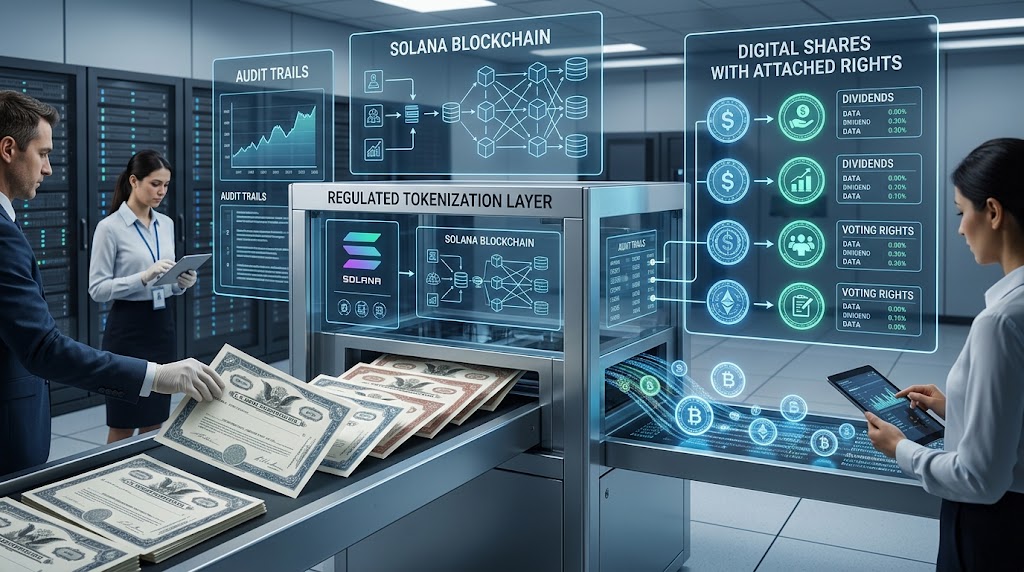
Securitize launched Securitize Stocks on October 8, offering eligible investors blockchain-based exposure to companies including Apple, Microsoft, Nvidia, Alphabet, Tesla, Meta and Amazon. The tokens initially trade on Solana through Securitize registered broker-dealer platform.
The structural point is more important than the list of names. Securitize says each token is backed one-for-one by the underlying share and preserves the economic benefits and shareholder rights attached to owning that security.
That moves tokenized equities from the regulatory architecture Optimisus has been covering into an actual investor product.
A Security Entitlement Is Not a Price Tracker
Most products called tokenized stocks have historically fallen into several different legal categories. Some are derivatives. Some are debt claims. Some are offshore wrappers that pass through only economic exposure.
Securitize is framing these tokens as security entitlements to real shares held through its regulated brokerage structure. Dividends and other economic benefits remain attached to the ownership claim.
That distinction matches the line U.S. regulators have been drawing this year. Optimisus explained it when the SEC opened a five-year innovation lane for tokenized National Market System stocks and excluded synthetic shares.
The token is useful because it changes how the security can move. It does not get to discard what the security legally is.
Solana Is the First Rail, Not the Final Venue
The initial launch uses Solana and Securitize own registered broker-dealer platform. Trading begins in extended U.S. hours, with 24/7 availability planned later.
The company also expects the tokens to reach other venues, including the New York Stock Exchange forthcoming round-the-clock platform and the planned OKXICE tokenized securities venue.
That is where interoperability becomes the real test. A tokenized share becomes meaningfully different from a broker database entry only if it can move across approved venues and custody environments without breaking the authoritative ownership record.
OKXICE Showed the Market Design. Securitize Supplies the Asset
Optimisus recently analyzed the OKX and Intercontinental Exchange joint venture that proposes permissioned Uniswap v4 pools for real U.S. securities.
That proposal needed a compliant tokenized security on one side of the pool and regulated digital cash on the other. Securitize Stocks are designed to be the kind of security entitlement that can fit into that architecture.
The two announcements therefore solve different pieces of the same problem: one creates the asset representation, the other designs a venue that could trade it.
The Rights Layer Is Harder Than the Blockchain Layer
Minting a token that tracks Nvidia is technically easy. Preserving voting, dividends, corporate actions, trading restrictions, ownership records and investor disclosures across blockchain transfers is the difficult part.
Stock splits must change the token correctly. Tender offers need a process. Voting deadlines need entitlement records. Restricted jurisdictions need controls. A trading halt in the traditional market raises the question of what happens to a token trading elsewhere.
Those are securities-infrastructure problems rather than smart-contract problems.
Optimisus covered the same convergence when Nasdaq invested $100 million in Kraken parent Payward while the companies built toward regulated tokenized equity infrastructure. The market is moving from wrappers toward systems that have to survive the boring events mature securities markets handle every day.
The 24/7 Promise Will Be Tested by the First Corporate Event at 2 A.M.
Round-the-clock access is the easiest benefit to market. It is not automatically the most valuable benefit.
The stronger case for tokenization is operational: faster settlement, more portable collateral, programmable servicing and a shared ownership record that can reduce reconciliation between intermediaries.
24/7 trading adds its own risks. Liquidity can be thin outside U.S. hours, reference prices can become stale, and material company news can break while the primary exchange is closed.
Securitize launching real rights-bearing shares is therefore an important milestone, but the product will prove itself through ordinary market operations rather than the first trade.
The decisive moment will be when a tokenized share crosses venues, receives a dividend, handles a stock split or participates in a vote without requiring a separate off-chain workaround. That is when tokenization stops being a new wrapper and starts becoming market infrastructure.
This is not financial advice.
Sources
- Securitize – Launches Global Onchain Trading of U.S. Stocks with Security Entitlements – Primary announcement of the Solana launch, eligible assets and rights structure.
- Reuters – Securitize launches blockchain-based stocks – Independent reporting on the launch and planned venue expansion.
- The Block – Securitize launches 1:1-backed tokenized stocks – Independent detail on backing, USDC settlement and initial products.