The phrase “tokenized stocks” has covered several very different products: synthetic price exposure, offshore wrappers, broker-issued claims and tokens backed one-for-one by securities held in custody.
OKX and Intercontinental Exchange are now proposing a U.S. venue designed to make that distinction explicit.
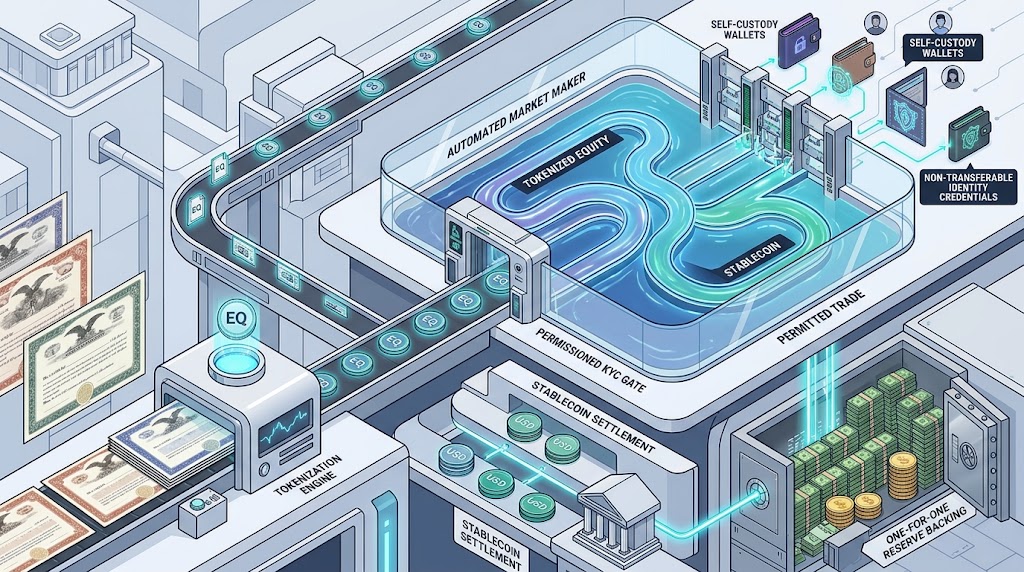
Their 50/50 joint venture, OKXICE TSV, filed a public notice describing a tokenized-securities market that would operate under the SEC’s temporary innovation exemption. The architecture combines one-for-one stock backing, self-custody, stablecoin settlement and permissioned automated market-maker pools built with Uniswap v4 on X Layer.
The interesting part is that almost every familiar DeFi component remains present. Access is what changes.
The AMM Is Uniswap v4. The Wallets Are Permissioned
The filing describes liquidity pools using Uniswap v4 smart contracts with an OKXICE-specific hook that enforces who can interact with them.
A wallet must pass KYC or KYB, anti-money-laundering, sanctions and wallet-screening checks. Approved wallets receive a non-transferable soulbound token that acts as an access credential.
Without that credential, the wallet cannot trade or provide liquidity in the venue’s pools.
That is a useful definition of regulated DeFi. The execution logic can remain on-chain and automated while identity and eligibility are enforced at the protocol boundary.
The Tokens Are Intended to Carry Real Securities Rights
The proposed structure is different from a perpetual contract that merely tracks the price of Apple or Tesla.
Under the notice, a third-party tokenizer would hold the underlying National Market System stock one-for-one through an SEC-registered broker-dealer and FINRA member. The token would represent a security entitlement to the share rather than a cash-settled synthetic price bet.
The design is intended to pass through economic rights including dividends and voting, with minting and redemption linked to the underlying stock and independent reserve attestations supporting the one-for-one backing.
That distinction is exactly why the SEC’s new tokenization lane matters. Optimisus previously explained that the five-year innovation exemption is aimed at tokenized U.S. stocks with real securities rights rather than synthetic shares.
Non-Custodial Does Not Mean Permissionless
OKXICE says the venue itself will be non-custodial and will not run a conventional order book or extend credit.
Those features sound crypto-native, but they should not be confused with an open protocol anyone can use.
The access credential can be issued only after compliance screening and can be revoked. The security itself exists inside a regulated ownership chain. Issuers can also object to participation under the SEC framework.
That is not a flaw in the design. It is the regulatory bargain that lets an automated market maker interact with real U.S. securities without pretending securities law disappears when a share becomes a token.
Stablecoins Become the Cash Leg of an Equity Market
The filing says tokenized stocks would trade against stablecoins including USDC, USDG and USDT.
That makes stablecoins more than a crypto trading pair. They become the settlement cash used inside a securities market.
The effect is subtle but important. Traditional equity markets rely on broker cash accounts, clearing banks and settlement systems. A tokenized venue can compress part of that movement into atomic transfers between a securities token and a dollar token.
The market is already moving in this direction from multiple sides. Optimisus recently covered Nasdaq investing $100 million in Kraken’s parent as tokenized-equity infrastructure moves closer to established exchanges, and separately the SEC proposal that could allow the corporate share register itself to live on a blockchain.
The Five-Year Exemption Is a Laboratory, Not a Permanent Exchange Charter
Reuters reports that the joint venture is seeking to operate under the SEC’s innovation exemption. The exemption creates a controlled route for qualifying tokenized-securities venues, but it is temporary and conditional.
OKXICE is not simply becoming a conventional national securities exchange with all normal Regulation NMS treatment switched on.
That is why the filing is so useful. It shows what the regulator is actually willing to test: on-chain AMMs, stablecoin settlement and self-custody, but inside identity controls, backing rules, security entitlements and issuer protections.
For years, “regulated DeFi” sounded like a contradiction because regulation normally acts through identifiable intermediaries while DeFi tries to remove them.
The OKXICE design suggests a different answer. Keep the automated execution. Put the regulation into the assets, access credentials and rules around the pool.
If the experiment works, the future tokenized stock market may look less like Robinhood with blockchain underneath and more like Uniswap with a securities-law perimeter around it.
This is not financial advice.
Sources
- OKXICE — Public Notice of Tokenized Securities Venue — Primary 27-page notice describing the joint venture, permissioned AMM architecture, token rights and access controls.
- Reuters — OKX joint venture files with SEC to launch tokenized trading platform — Independent reporting on the filing and proposed U.S. launch.