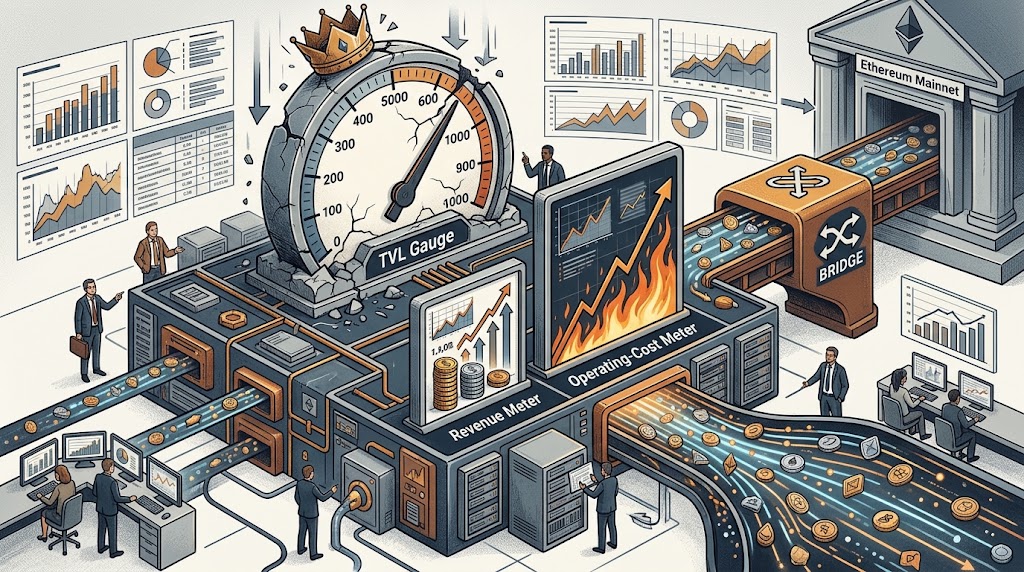
Blast once had more than $2 billion deposited before its mainnet was even live.
On October 2, the Ethereum Layer 2 announced that it is shutting down.
The reason was not a hack, a regulator or a failed consensus upgrade. Blast said the ongoing cost of operating the network exceeded the revenue it generated and that it did not see a credible path to economic sustainability.
That makes the shutdown more useful than another postmortem about a broken bridge. Blast is a case study in something crypto infrastructure often avoids measuring: a chain can attract billions of dollars and still fail as a business.
TVL Was Never Revenue
Total value locked became the default scoreboard for DeFi because it is easy to see and easy to compare. It is not an income statement.
Capital can sit on a network because incentives are attractive, because an airdrop is expected or because assets earn native yield. None of those facts guarantees that the chain itself earns enough fees to pay for its operation.
Blast was unusually good at attracting deposits before launch. The Block reports that the network had more than $2 billion in TVL from nearly 200,000 early-access users before its February 2024 mainnet launch.
By the time the shutdown was announced, that figure had fallen to a little over $32 million.
The decline is dramatic, but the decisive statement came from Blast itself: maintaining the L2 costs more than the revenue it produces.
Native Yield Attracted Capital Faster Than Durable Demand
Blast differentiated itself by making ETH and stablecoin balances yield-bearing by default. ETH yield came through staking, while stablecoin yield drew on real-world-asset protocols.
That was clever product design because idle balances on most chains earn nothing unless users actively deploy them.
It also created a strong reason to bridge capital before there was an equally strong reason to use applications on the network.
Incentivized deposits can bootstrap liquidity. The harder phase begins when rewards normalize and the chain has to earn activity that remains because users need the applications, not because the balance itself is subsidized.
Rollups Have Costs Even When Users Do Not See Them
The language of scaling can make an L2 sound like software that, once deployed, runs almost for free.
It does not. A rollup needs sequencer and node infrastructure, bridge operations, data publication to Ethereum, engineering, monitoring, security work, user support and continued protocol maintenance.
Some of those costs fall as technology improves. Others grow with complexity.
Ethereum itself is pushing aggressively to make rollup economics better. Optimisus has covered how Glamsterdam is changing block construction and execution architecture to increase capacity at the base layer. Cheaper Ethereum data helps L2s, but it cannot manufacture application demand for a chain that lacks it.
The Exit Path Matters More Than the Token Price
Blast is asking users to withdraw assets back to Ethereum.
According to The Block, the network first began withdrawing its Lido assets, a process expected to take about a week. Withdrawals are temporarily unavailable during that operation. Afterward, they are expected to resume with a 24-hour delay.
The normal Blast interface is scheduled to remain available until October 26. After that, users will need to interact directly with Blast bridge contracts on Ethereum.
That last detail is important for anyone evaluating a rollup. A chain is not only an execution environment. It is also an exit mechanism.
Users should know what happens if the front end disappears, the operator winds down or the business behind the sequencer no longer wants to run it.
The L2 Market Is Entering Its Consolidation Phase
The shutdown does not mean the rollup thesis failed.
It means not every rollup deserves to survive.
The first stage of the L2 market rewarded launching a chain, attracting liquidity and announcing an ecosystem. The next stage has to reward chains that can keep users, developers and transaction activity at a level that supports their operating model.
That is healthier for the sector even if it looks worse on a dashboard.
A network with $2 billion of incentive-driven TVL can appear more successful than a smaller chain with recurring fee-paying users. Blast’s wind-down exposes why those metrics need to be separated.
The lesson is not that TVL is useless. It is that TVL measures assets parked in a system. Revenue measures whether the system can keep paying to exist.
For Layer 2s, 2026 may be the year the difference finally stopped being theoretical.
This is not financial advice.
Sources
- The Block — Paradigm-backed Layer 2 Blast to wind down network — Independent reporting on the shutdown, TVL history and withdrawal timetable.
- DeFiLlama — Blast chain dashboard — Live public dashboard for Blast TVL, fees and activity context.