Binance’s perpetual volume on traditional assets including US stocks and ETFs reached roughly $445 billion in July, up from about $30 billion in January.
That is a fifteenfold increase in seven months.
The exchange has since been adding US stock options, which is a different product with different regulatory implications.
What Is Actually Being Traded
A perpetual future on a stock is not the stock. It is a derivative contract that tracks the price, with no expiry, anchored to spot through a periodic funding rate.
The mechanism originated in crypto markets and is now being applied to equities, which is a reversal of the usual direction of financial innovation.
The appeal for users outside the US is straightforward. Equity exposure, around the clock, with leverage, settled in stablecoins, without a brokerage account or a custody relationship in a foreign jurisdiction.
The stack forming underneath is broader than perpetuals alone. Reporting describes crypto, stocks, ETFs, tokenized equities, TradFi perpetuals and now US stock options sitting in one account rather than across three or four platforms.
Why the Single Account Is the Real Change
The individual products are not novel. Consolidating them into one margin pool is.
A trader holding crypto, equity perpetuals and options in the same account can cross-margin between them. That is capital efficient and it is exactly the structure that concentrates risk.
In traditional finance, equity, derivatives and digital asset exposures typically sit in separately regulated entities with separate margin. A single pool removes that firebreak.
The 2022 failures in crypto came substantially from concentrated positions and rehypothecated collateral inside single entities. Adding equity exposure to the same structure does not reduce that risk.
The Regulatory Position Is Unresolved
US persons are generally restricted from these products, and that restriction is doing considerable work.
Everyone else gets synthetic exposure to US equities without the disclosure, investor protection and market conduct rules that attach to trading the actual securities.
Regulators have not settled whether a perpetual future on a US-listed stock, offered offshore to non-US persons, falls within any US securities regime. The answer has consequences for market data licensing, manipulation oversight and settlement integrity.
The direction of travel elsewhere is toward tighter perimeter control. Optimisus has covered several jurisdictions restricting offshore access this year, including South Korea making offshore funding slow rather than banning it.
A product that grows fifteenfold in seven months tends to attract exactly that kind of attention.
The Convergence Is Happening From Both Ends
This is the more interesting frame. Crypto exchanges are adding equities while traditional institutions add crypto rails.
ICE, parent of the New York Stock Exchange, invested in tZERO to build tokenized securities infrastructure. DTCC partnered with BitGo on tokenized treasuries and equities. The SEC proposed permitting corporate share registers on distributed ledgers.
Optimisus covered the institutional side in the piece on tokenized real-world assets entering regulated markets.
Two systems are building toward the same destination from opposite directions, under entirely different regulatory regimes, and they will meet somewhere that neither set of rules currently describes.
What Users Should Understand
A perpetual future on a stock does not confer ownership, voting rights or dividends, and it carries funding costs that accumulate against you when positioning is crowded.
It also carries counterparty risk to the exchange rather than to a regulated clearing house.
Leverage mechanics across venues are covered in our day trading risk guide.
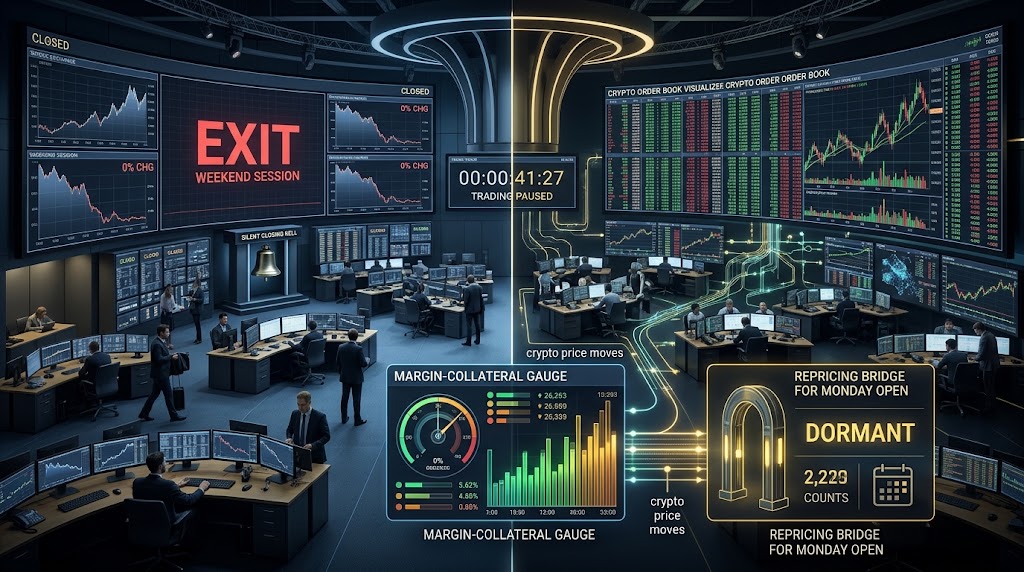
For anyone using these products, the sensible checks are what happens during a US market halt, how the funding rate behaves when the underlying is closed, and what the exchange does if the reference price feed fails.
None of those are hypothetical. Equity markets close, halt and gap, and a round-the-clock derivative on a market that is not always open has to handle that somehow.
Sources
- Crypto Integrated, Crypto news September 2, 2026 — https://www.cryptointegrat.com/p/crypto-news-september-2-2026
- KuCoin, Crypto daily market report, September 1, 2026 — https://www.kucoin.com/news/articles/crypto-daily-market-report-september-1-2026
- Bitcoin News Digest, September 2, 2026 — https://bitcoinnewsdigest.substack.com/p/bitcoin-news-digest-september-2-2026
- The Block, Coinbase and Better make token-backed mortgages generally available — https://www.theblock.co/news/business/2026-08-26-coinbase-better-make-token-backed-mortgages-generally-available-412810
This is not financial advice.
Optimisus covers crypto and technology news for readers who want the detail behind the headline.