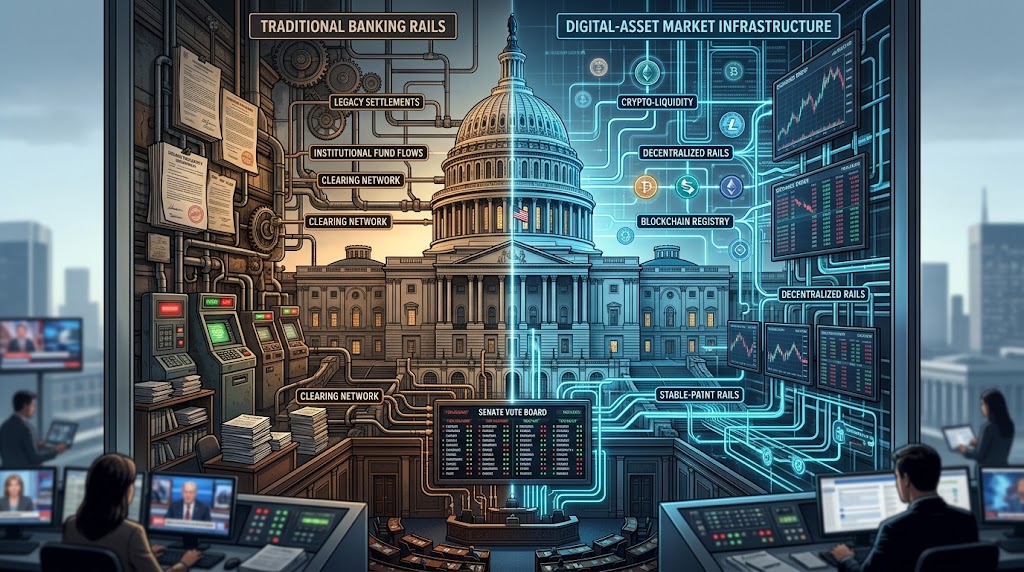
The updated CLARITY Act would set rules for token oversight, stablecoin rewards, anti-money-laundering duties and decentralized finance, but the bill still needs bipartisan support.
A revised version of the Digital Asset Market Clarity Act has reached the US Senate at a difficult moment, with lawmakers attempting to resolve major disputes before the chamber leaves for its August recess.
Senator Cynthia Lummis released updated text on July 22, saying it combined work from the Senate Banking and Agriculture committees. The proposed framework is intended to clarify how digital assets, exchanges and decentralized platforms would be regulated in the United States.
The bill has not become law. It still requires sufficient support in the Senate, passage through Congress and a presidential signature. Several provisions would also require regulators to write detailed implementing rules after enactment.
The bill would redraw crypto oversight
A central goal of the legislation is to establish clearer boundaries between the Securities and Exchange Commission and the Commodity Futures Trading Commission. The broader market has spent years operating under uncertainty over when a token or transaction falls under securities law and when it should be treated as a digital commodity.
The current Senate text also addresses fundraising, exchange registration, anti-money-laundering duties, decentralized finance and tokenized traditional assets. Supporters argue that a statutory framework would replace enforcement-driven uncertainty with rules companies can follow before launching products.
Stablecoin rewards remain a major point of conflict
The draft would restrict rewards paid simply for holding stablecoins in an idle balance, while allowing incentives linked to transaction activity, such as payments. The SEC, CFTC and Treasury would be directed to develop joint rules for the provision.
Banks have argued that interest-like stablecoin rewards could pull deposits away from the regulated banking system. Crypto companies counter that broad restrictions could protect banks from competition and limit new payment products. The disagreement has become one of the most difficult commercial issues in the negotiations.
Crypto exchanges would face bank-style AML requirements
The legislation would treat digital commodity exchanges, brokers and dealers as financial institutions under the Bank Secrecy Act. That would bring customer-identification, due-diligence, transaction-monitoring and suspicious-activity-reporting requirements into the statutory framework for covered crypto firms.
The provision would not remove compliance obligations from major exchanges. Instead, it would make those obligations more explicit and place them closer to the regime already applied to banks and other regulated financial intermediaries.
The draft creates a fundraising exemption for crypto projects
According to the updated proposal, qualifying crypto companies could raise up to $50 million in a year and up to $200 million in total without completing a full SEC registration. Tokens associated with investment contracts could still be sold under the framework, but with a reduced regulatory burden.
That provision could give early-stage projects a clearer fundraising route, although disclosure requirements and eligibility conditions would determine how useful the exemption becomes in practice.
DeFi platforms would be tested for genuine decentralization
The bill attempts to define when a decentralized platform is sufficiently independent from a controlling operator. A service could fail the test if a person or entity can block users, exercise private permissions or use hard-coded privileges unavailable to ordinary participants.
Platforms that do not meet the decentralization standard could be treated more like financial institutions, including obligations to monitor activity and report suspicious transactions. The approach is intended to separate autonomous protocols from products that use decentralized branding while retaining central control.
Tokenized securities would remain securities
The draft would also make clear that placing a stock, bond or other security on a blockchain does not remove it from securities law. Tokenized securities would generally be regulated in line with the underlying instruments they represent.
That clarification is increasingly important as exchanges and financial companies experiment with blockchain-based versions of equities and other real-world assets.
Political ethics and bipartisan votes could decide the timetable
The updated text includes restrictions that would prevent certain senior political officials from issuing or sponsoring digital assets until January 2029. Democrats have pressed for stronger safeguards around officials profiting from crypto ventures, while questions remain over how the proposed ban would be enforced.
The bill needs at least eight Democratic votes to advance in the Senate. Current reporting indicates that ethics provisions, consumer protections and bank objections to stablecoin rewards remain unresolved as the recess approaches.
A delay would not automatically kill the bill
Missing the pre-recess window would not formally end the legislation, but it could make the path more difficult. The Senate will return to a crowded calendar during a midterm-election year, when bipartisan financial legislation may become harder to complete.
For crypto companies and investors, the immediate position is unchanged: the updated CLARITY Act is a proposal, not a new regulatory regime. Its significance lies in how close Congress may be to defining market structure through legislation rather than leaving the boundaries primarily to agency interpretation and court cases.
Sources
1. Senator Cynthia Lummis: Updated CLARITY Act text
2. US Senate Banking Committee: Market structure bill text