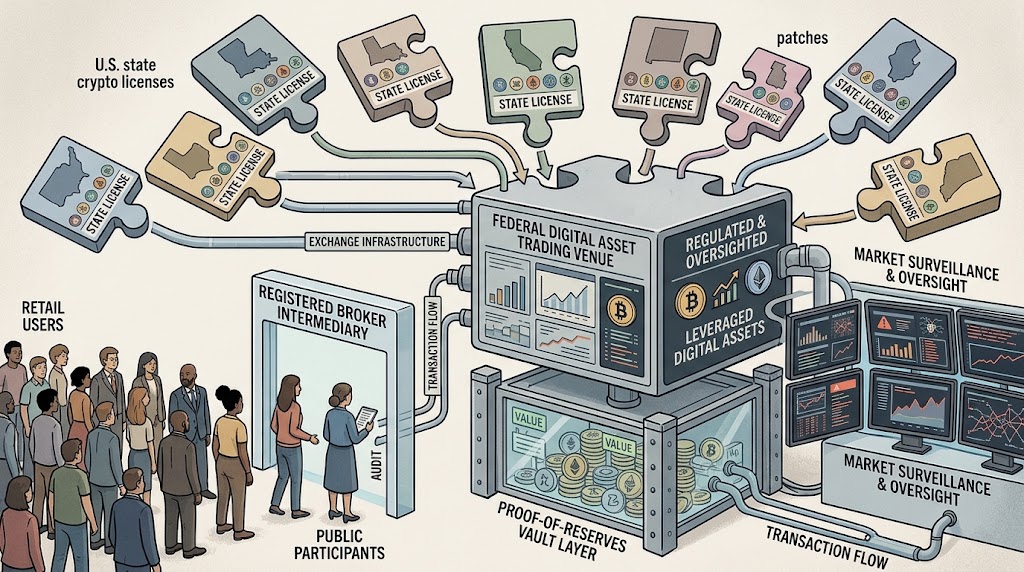
Coinbase has finished integrating Deribit, and the result is bigger than adding options to another trading screen.
The combined platform is now Coinbase Global Exchange. Coinbase says Coinbase Financial Markets will soon connect eligible U.S. clients to the same global crypto derivatives liquidity used across its international business.
Deribit entered the deal as the dominant crypto-options venue. Coinbase says the integrated platform had access to more than $30 billion in bitcoin options open interest as of September 30 and processed more than $1 trillion in trading volume last year.
The strategic change is that U.S. regulated access and offshore-style crypto derivatives are no longer being treated as separate markets inside Coinbase’s architecture.
The Regulatory Bridge Was Built Before the Product Integration
The key entity is Coinbase Financial Markets, Coinbase’s U.S.-regulated futures commission merchant.
In May, the CFTC provided a path that Coinbase says allows CFM to connect eligible U.S. clients to global crypto options and perpetual-futures liquidity.
That matters because Deribit itself was historically part of the international crypto market. U.S. institutions wanting access to that liquidity typically needed offshore entities, separate counterparties and fragmented custody relationships.
Coinbase is trying to collapse that into one regulated account and one risk view.
Optimisus covered the institutional foundation when Coinbase obtained its own derivatives clearing organization and completed its broker, exchange and clearing stack. The Deribit integration adds global options liquidity on top of that regulatory plumbing.
Unified Liquidity Changes Margin Economics
Combining venues is not only about offering more symbols.
Coinbase says the platform will use unified portfolios, cross-portfolio risk modeling and multi-asset margin offsets. In practical terms, positions that hedge each other can reduce the amount of collateral that has to sit idle as margin.
That is how professional derivatives markets become capital efficient. A trader long spot bitcoin and short a related derivative should not necessarily have to collateralize both positions as if they were independent bets.
The challenge is that unified margin also makes the risk engine more important. If correlations change violently or liquidity disappears, the platform has to calculate liquidation risk across a more complex portfolio rather than one isolated position.
Coinbase Is Rebuilding the Exchange Around Derivatives
The company says Deribit’s next-generation matching engine now powers the combined derivatives infrastructure.
Options are being added for eligible users, spot margin is rolling out in supported jurisdictions, and Coinbase Pro is scheduled to return by year-end as a professional platform spanning spot, futures, perpetuals, options and equities.
The direction is clear: Coinbase no longer wants to be defined primarily as a spot crypto exchange.
That change mirrors the structure of global crypto markets. Coinbase notes that derivatives have historically represented roughly 80% of total crypto trading volume worldwide. Spot is where many users enter the asset class; derivatives are where professional risk transfer happens.
The U.S. Version Still Has Eligibility Boundaries
A global liquidity pool does not mean every product becomes available to every U.S. retail user immediately.
Coinbase says options through Prime are coming for U.S. institutional clients, while retail U.S. options access is expected later. Product availability still depends on jurisdiction, customer classification and the entity providing the service.
That distinction matters because crypto platforms often market a unified experience while the legal reality remains a stack of separate regulated entities.
The interface can look like one exchange. The contract, custodian, broker and venue behind a trade can still differ depending on where the customer lives and what they are trading.
This Is the Regulated Version of the Market Crypto Already Built Offshore
Perpetual futures and options were not waiting for U.S. regulatory clarity. They became the center of crypto market structure years ago.
Optimisus documented the irony when BitMEX shut down after helping popularize the perpetual swap that the rest of the market copied.
Coinbase is now trying to pull that market design into a regulatory structure that U.S. institutions can use without recreating an offshore operating stack.
If it succeeds, the competitive advantage is not merely that Coinbase has options. It is that a regulated U.S. customer can reach deeper global derivatives liquidity while keeping custody, margin and compliance inside a connected system.
The next number to watch is therefore not the number of products listed. It is whether liquidity actually consolidates around the shared book, especially when markets become volatile enough that traders care more about depth than interface.
This is not financial advice.
Sources
- Coinbase — Coinbase Is Building the Most Complete Trading Platform — Primary announcement covering the completed Deribit integration, global liquidity pool, options, spot margin and Coinbase Pro relaunch.
- Coinbase Help — Coinbase International Exchange and Deribit Are Coming Together — Operational detail on the October 1 migration, combined matching engine and product changes.
- The Block — Coinbase Pro to return; Deribit integration creates Coinbase Global Exchange — Independent reporting on the integration and U.S. access.