Most digital advertising is placed around content after someone has decided what they want to consume.
OpenAI is testing a format that appears while the content is being made.
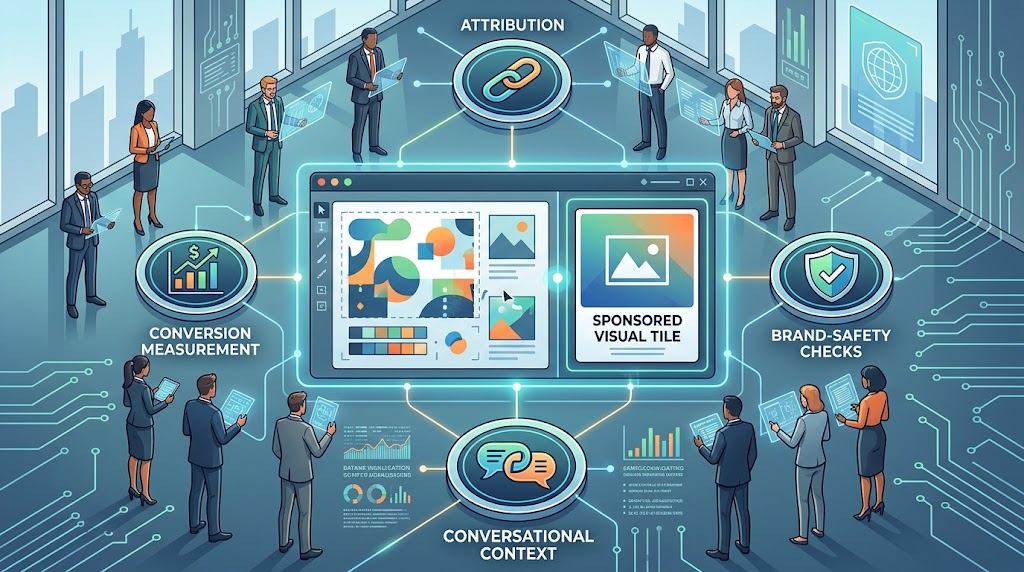
On October 5, the company announced a new visual advertising format in ChatGPT that will initially be tested during image generation. OpenAI says the ads will be clearly labeled, remain separate from the generated image and will not influence ChatGPT’s answers.
Testing is scheduled to begin later in October in the United States with an initial group of advertisers.
The format matters less because it contains an image and more because of the moment in which the ad can appear: while a user is actively imagining, designing or deciding something.
The Ad Is Beside the Creation, Not Inside It
OpenAI is drawing a clear product boundary around the experiment.
The sponsored visual is not inserted into the image a user asked the model to generate. It sits separately and is labeled as advertising.
That distinction protects two things at once. The user’s output remains the user’s requested output, and the model’s answer is not supposed to change because an advertiser paid for placement.
For generative products, that separation is more important than it would be on a conventional webpage. If a sponsored brand could silently alter the generated result, users would have no reliable way to distinguish recommendation from advertising.
AI Ad Inventory Is Contextual in a Different Way
Search advertising is built around queries. Social advertising is built around feeds, identity signals and behavioral prediction. Conversational AI creates a third context: a multi-step task.
Someone generating an image may be planning a room, designing an invitation, imagining a travel itinerary, comparing a product aesthetic or preparing marketing material.
That context can be commercially valuable because the user is not simply browsing. They may already be constructing the thing that precedes a purchase.
OpenAI says ChatGPT reaches 1.2 billion people each week. At that scale, the commercial opportunity is obvious. The difficult part is monetizing a task-oriented conversation without making every useful interaction feel like a sales funnel.
Measurement Is the Real Infrastructure Rollout
The ad format is visually new. The measurement stack may be the more consequential part of the announcement.
OpenAI is expanding integrations that let advertisers send conversion information from systems they already use, including Hightouch, Tealium and LiveRamp. It is also working with attribution, incrementality and measurement providers across the advertising ecosystem.
That is what turns an experimental placement into an ad market.
Brands do not scale spending because an ad looks interesting. They scale when they can connect exposure to a business outcome and compare the result with other channels.
OpenAI is therefore building the plumbing needed for ChatGPT Ads to compete for budget rather than novelty.
Brand Safety Is Harder in a Conversation Than on a Page
A webpage can be categorized by URL, publisher and content. A conversation changes from one turn to the next.
That makes brand suitability a different problem. An advertiser may be comfortable appearing beside a home-design task and uncomfortable appearing two messages later if the same conversation moves into a sensitive topic.
OpenAI says it has been working with verification companies including DoubleVerify and Integral Ad Science on brand-suitability approaches without giving those partners access to private conversations.
That is the correct constraint, but technically it is difficult. The system has to decide whether an ad context is appropriate while preserving the privacy boundary around the conversation itself.
Advertising Changes the AI Business Model Above the Model Layer
The frontier-model market is already difficult to monetize through raw inference alone. Prices change quickly, models are replaced quickly and users increasingly expect capable assistants at low or no direct cost.
Optimisus has covered how frontier model releases have become a maintenance problem rather than a simple capability race, and how OpenAI has started bundling models with vertical data and workflows in ChatGPT for Financial Services.
Advertising adds another business layer: monetization tied to user intent rather than tokens consumed.
That can broaden access, as OpenAI argues. It also raises the trust requirement. If users begin to believe the assistant’s answer changes to favor advertisers, the value of the interface itself falls.
OpenAI’s public line is therefore not a small disclaimer. It is the core economic condition for the format: ads can sit next to the work, but they cannot become the hidden reason the work says what it says.
The Creation Moment May Be the Most Valuable Moment
The first test is image generation, but the broader pattern is easy to see.
AI systems increasingly sit before the purchase, not after it. They help users decide what a living room should look like, which laptop features matter, how to structure a trip or what type of software fits a workflow.
Advertising that enters those moments can be more useful than a banner shown after the decision has already been made.
It can also become more intrusive if relevance turns into steering.
That is why the separation between generated output, model answer and paid placement will matter more in AI than it ever did in a search-results page.
Sources
- OpenAI — Building advertising for the way people use AI — Primary announcement of visual ads, measurement expansion and brand-suitability work.
- OpenAI Ads — More ways to measure ChatGPT Ads — Primary detail on conversion, attribution and incrementality tooling.
- TechCrunch — OpenAI launches visual ads alongside image-generation results — Independent reporting on the new format and U.S. testing.