Samsung is putting a dollar stablecoin inside a mainstream phone wallet.
Starting in the last week of October, eligible U.S. Galaxy users will be able to access USDC through Samsung Wallet. Samsung says the feature will be available across 82 million compatible Galaxy devices, support transfers to compatible crypto wallets and allow eligible users to send money to qualifying bank accounts in more than 60 countries, where recipients may receive local currency.
The headline looks like a crypto-distribution deal. The product design is more interesting than that.
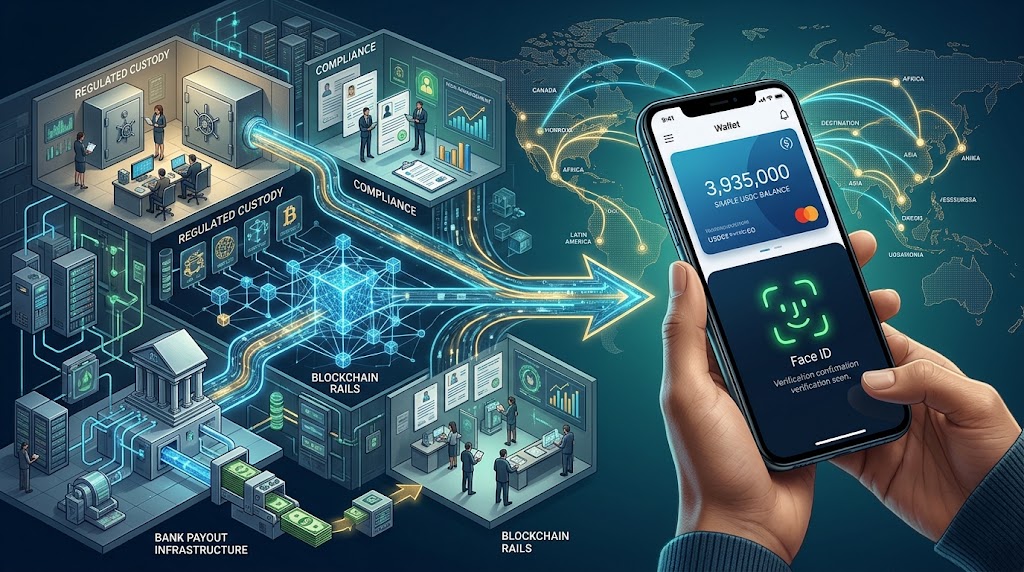
Samsung is deliberately trying to make the user experience feel like a normal wallet product rather than a crypto wallet. Users do not need to install a separate crypto application or manage private keys themselves. Custody, compliance and settlement sit behind the interface.
The Stablecoin Is Visible. The Blockchain Mostly Is Not
USDC will appear as the default dollar stablecoin when users select the stablecoin feature in Samsung Wallet.
But the user is not being asked to choose a validator, create a seed phrase or understand the difference between a custodial address and a self-hosted one before sending money.
Samsung says stablecoin accounts and money movement are provided by regulated partners. Bastion runs the stablecoin account and cross-border payment infrastructure. Coinbase acts as sub-custodian through Coinbase Prime Vault. Solana and Sui are among the partners providing blockchain network support.
That separation is the direction stablecoin adoption has been moving toward for years. The blockchain remains the settlement rail, while the interface looks increasingly like ordinary financial software.
This Is a Remittance Product Before It Is a Crypto Product
The most useful feature is not buying USDC. It is what can happen after the balance exists.
Eligible users can send USDC to compatible wallets internationally, and Samsung says it will not charge a fee for those external USDC transfers, although recipient platforms can still charge their own fees.
More importantly for mainstream use, the wallet can route transfers to eligible bank accounts in more than 60 countries and deliver local currency to the recipient.
That means the sender can use stablecoin infrastructure without requiring the person receiving money to own crypto at all.
The product therefore competes less directly with a trading exchange and more directly with cross-border transfer services. The stablecoin is the internal rail that lets the wallet move value between regulated endpoints.
The GENIUS Act Is Sitting Under the Consumer Experience
Samsung explicitly links the launch to the establishment of a U.S. regulatory framework for stablecoins.
That matters because distribution at this scale requires companies such as Samsung to know who is legally responsible for custody, compliance, reserves and money movement.
Optimisus recently covered how the Federal Reserve started translating the GENIUS Act into reserve, capital and safekeeping requirements for supervised issuers. Those rules sound far removed from a phone wallet. They are exactly the kind of infrastructure that makes a consumer brand more willing to put stablecoin functionality inside a mainstream product.
Custodial Convenience Changes the Risk Model
Removing private-key management is a usability improvement. It also changes what ownership means.
A user holding USDC through this Samsung Wallet setup is relying on a chain of regulated service providers rather than controlling the asset with a private key directly. The service can enforce identity verification, sanctions restrictions and account-level controls because it is designed as a regulated financial product.
That is different from sending USDC from a self-custodied wallet, where the user controls the signing key even though the token issuer can still have contract-level freeze powers.
Optimisus has covered the distinction in other tokenized assets too. The SILV hack showed how a token can sit in a self-custody wallet while issuer-level freeze or delegate permissions still exist. Consumer stablecoin products add another layer: the wallet account itself may also be custodial.
Stablecoin Adoption May Look Like Stablecoins Disappearing
The most important metric will not be how many Samsung users call themselves crypto users.
If the product works, many of them may never think of themselves that way.
They will top up a dollar balance, authenticate with biometrics, send money and let the backend decide how the transfer moves. The stablecoin becomes infrastructure in the same way card networks and correspondent banks are infrastructure today.
That is a different adoption curve from the one crypto spent a decade measuring through exchange accounts and self-hosted wallets.
Optimisus previously noted that stablecoin supply can fall while transaction usage rises sharply. Samsung’s design is another reason raw wallet counts may become less useful. One regulated interface can represent millions of users without each user behaving like an onchain native.
The test for Samsung Wallet is therefore simple: can stablecoin rails make an international transfer feel ordinary enough that the user stops caring which rail was used?
This is not financial advice.
Sources
- Samsung Newsroom — Samsung Wallet to Bring Stablecoin Access to Eligible Galaxy Users in the US — Primary announcement covering the 82 million compatible devices, 60+ bank-account corridors, custody model and launch timing.
- Coinbase — Coinbase and Samsung Bring USDC to Samsung Wallet — Primary detail on Coinbase Prime custody and USDC as the default dollar stablecoin.