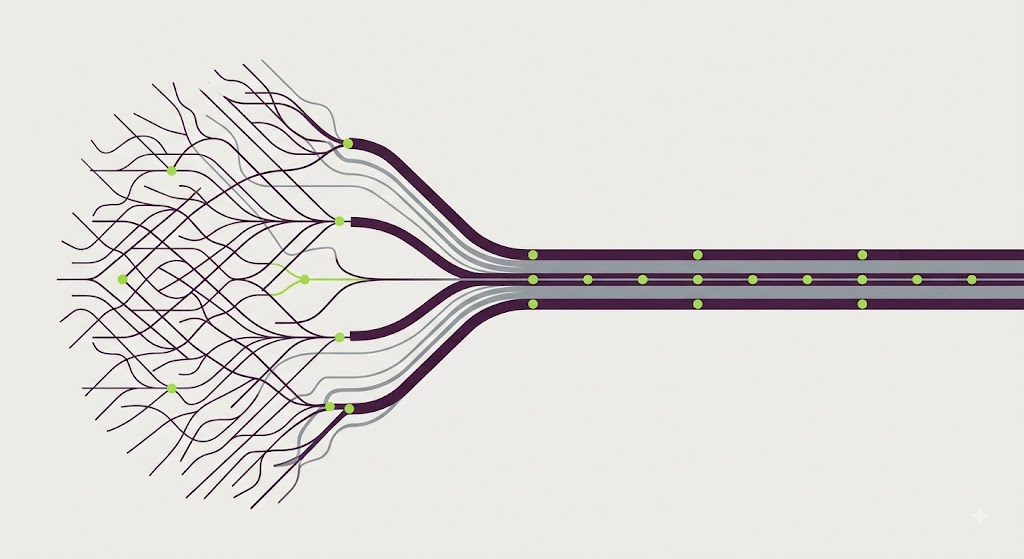
Proof of History was Solana’s signature invention. It is being retired.
Alpenglow replaces both Proof of History and TowerBFT with two new components. Validators voted 98.27% in favor back in September 2025, with roughly 52% of staked tokens participating.
The rollout is now staged across August to October 2026, and there is one administrative step that decides whether a validator stays on the network.
The Step That Locks People Out
Validators must register a BLS public key on-chain before the Validator Admission Ticket feature gate activates.
The BLS key management change, SIMD-0387, is already live on mainnet. The admission ticket itself, SIMD-0357, activates separately.
A validator that has not registered its BLS key will not be admitted under Alpenglow consensus once that gate turns on. The node does not degrade or warn. It simply does not join.
This is a small task with a binary outcome, which is exactly the kind that gets missed. Solana has removed validators from the network before, though for very different reasons, as Optimisus covered when it expelled validators for manipulating transactions.
What Votor Actually Changes
Under the current design, validators publish their votes as ordinary on-chain transactions. Those votes consume roughly 75% of Solana’s total block space.
The network has been spending three quarters of its capacity talking to itself.
Votor moves that off-chain. Validators exchange signed messages directly and combine them into compact certificates, which frees the reclaimed block space for actual transactions.
It also collapses the voting process. The current mechanism runs many rounds; Votor finalizes in one or two.
The dual-path design is the interesting part. If 80% of staked weight votes, a block finalizes in a single round. If 60% votes, it takes two. Both paths run concurrently.
Alpenglow tolerates 20% adversarial stake plus 20% offline stake and still reaches consensus. TowerBFT requires a supermajority above two thirds.
| Component | Replaces | Purpose |
| Votor | TowerBFT and Proof of History | Off-chain voting, one or two round finality |
| Rotor | Turbine | Faster block propagation via a single relay layer |
| SIMD-0387 | n/a | BLS key registration, already live |
| SIMD-0357 | n/a | Validator Admission Ticket gate |
Rotor Comes Later
This is the part most coverage collapses. Alpenglow is not a single switch.
Votor ships first. Rotor, which replaces the Turbine block propagation system, is planned for a later phase once Votor has been adopted.
Rotor keeps Turbine’s erasure coding and stake-adjusted bandwidth but changes the propagation plan from a tree of nodes to a single relay layer, cutting latency. Lab tests have shown block propagation completing in as little as 18 milliseconds.
So headlines describing Alpenglow as live are describing phase one. The full architecture arrives across two separate activations.
The Finality Number Needs Care
The headline claim is a drop from about 12.8 seconds to roughly 150 milliseconds. Some sources say 100 to 150 milliseconds.
That comparison is not quite like for like. Solana’s current pre-confirmation latency is around 400 milliseconds, and most user-facing applications already treat that as the practical wait rather than the 12.8-second TowerBFT finality.
The real change is that full finality catches up to something close to pre-confirmation speed. That matters most for applications where settlement certainty is the constraint, not perceived speed.
The upgrade also introduces a fixed 400-millisecond block time with local timeouts tolerating up to 5% clock drift.
The Date Has Moved More Than Once
Worth flagging, because published timelines conflict.
Earlier reporting had Alpenglow reaching testnet in December 2025 and mainnet in the first quarter of 2026. Later guidance pointed to early to mid-2026, then to the third quarter.
Current reporting describes staged activation between August and October 2026, with acknowledgment that the timetable can change during testing.
A community test cluster went live on May 11. Devnet runs through a build called Agave 4.3, and the change is breaking, so node teams need to prepare in advance rather than upgrade on the day.
Anything quoting a first-quarter or mid-year date is stale.
The Risk Nobody Should Skip
Replacing the consensus layer of a live network carrying billions in value is not a routine upgrade.
Results from a controlled test cluster do not automatically replicate across thousands of globally distributed validators. Migration has to be seamless, and Solana’s history of network halts makes this a reputational as well as a technical event.
If it works, Solana becomes the fastest major chain by a wide margin. If it falters during mainnet activation, the damage runs deeper than previous outages because the failure would sit in the consensus layer itself.
Solana has been shipping capacity increases alongside this, including when it raised block capacity 66% with a compute unit upgrade.
Separate work is underway on longer-horizon threats, including Project Eleven’s post-quantum security effort for the network.
What to Watch
SOL traded around $75 to $77 this month, down substantially year over year.
The near-term marker is the Validator Admission Ticket gate activating and how many validators fail to register in time. That number is the first real measure of whether the ecosystem is ready.
After that, watch whether finality figures on mainnet match the test cluster. Lab conditions and a live global validator set are different environments, and the gap between them is where this upgrade will be judged.
Sources
- Solana, Alpenglow upgrade documentation and shipping timeline — https://solana.com/upgrades/alpenglow
- Bitfinex blog, Why Solana’s Alpenglow upgrade is more than just about speed — https://blog.bitfinex.com/industry-news/why-solanas-alpenglow-upgrade-is-more-than-just-about-speed/
- TheStreet Crypto, Solana’s biggest upgrade in history is now live for testing — https://www.thestreet.com/crypto/innovation/solanas-biggest-upgrade-in-history-is-now-live-for-testing
- Yahoo Finance, Solana prepares for the Alpenglow upgrade — https://finance.yahoo.com/markets/crypto/articles/solana-prepares-alpenglow-upgrade-sol-123914197.html
- Backpack, Solana Alpenglow upgrade explained — https://learn.backpack.exchange/articles/solana-alpenglow-upgrade
- Coin Gabbar, Solana Alpenglow upgrade, speed, consensus and timeline — https://www.coingabbar.com/en/crypto-blogs-details/solana-alpenglow-upgrade-speed-consensus-timeline-release-date
This is not financial advice.
Optimisus covers crypto and technology news for readers who want the details behind the headline.