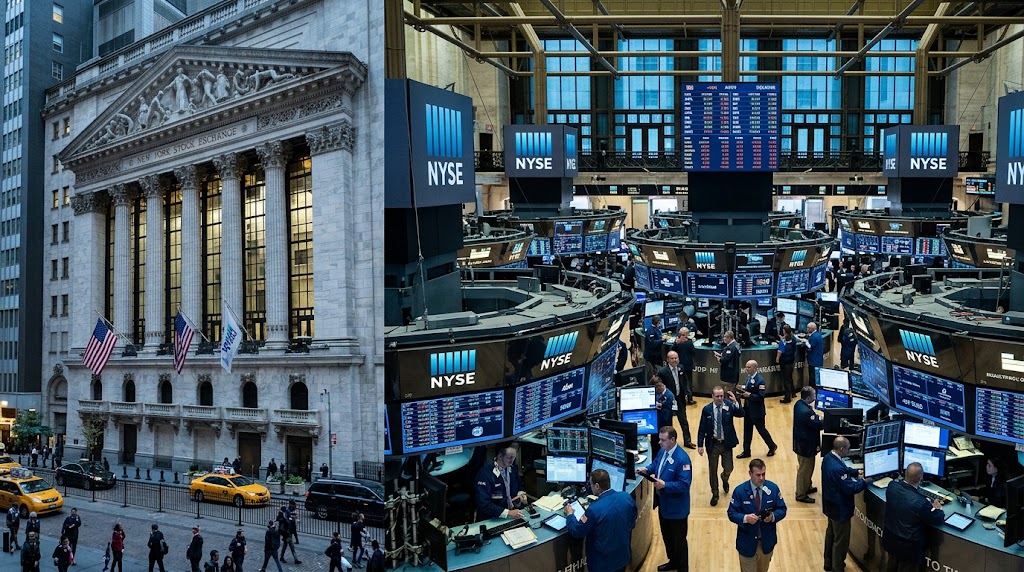
The New York Stock Exchange has added four more transfer-agent firms to support its planned tokenized-securities marketplace. Broadridge Financial Solutions, Computershare, Equiniti and Superstate join previously announced partners Securitize and tZERO. The November 2 announcement brings the named network to six firms.
This is not the launch of 24-hour trading in tokenized Apple or Nvidia shares on an NYSE-branded blockchain market. The NYSE says the proposed affiliated venue remains subject to regulatory approval. What the new agreements do is address a less visible requirement: who maintains the official record of ownership and handles shareholder services when a security exists in tokenized form.
The transfer agent is not an optional extra
In traditional U.S. equities, transfer agents maintain issuer records and coordinate important corporate actions. A digital representation of a share still needs reliable answers to basic questions. Who owns it? What rights does that holder receive? How do dividends, votes and changes to the shareholder register work? What happens when a token is lost or a court order requires a correction?
The NYSE describes a structure supporting both issuer-sponsored tokenized securities and third-party custodial tokens. Its announcement says the intended tokens would be fungible with traditionally issued securities and give holders equivalent dividend and governance rights. Those are design objectives of the proposed market, not proof that each implementation has already completed legal and regulatory review.
The mix of new partners is notable. Companies such as Computershare, Equiniti and Broadridge bring existing corporate-issuer relationships and operational scale. Securitize, tZERO and Superstate bring experience with blockchain-based recordkeeping and digital securities. The NYSE says the traditional firms together serve nearly 5,000 listed companies, including almost 99% of the S&P 500. That is a measure of their reach, not a statement that those issuers have agreed to tokenize their shares.
What the proposed venue would change
The NYSE’s public plan includes round-the-clock operations, instant settlement, orders denominated in dollars, stablecoin-based funding and blockchain post-trade systems. Its established Pillar matching engine would sit alongside newer settlement and custody infrastructure, with multiple chains potentially supported.
Each feature introduces a practical question. Instant settlement compresses the time normally used for financing, reconciliation and error correction. Trading outside ordinary market hours changes liquidity conditions. Stablecoin funding brings a different set of operational and issuer risks from conventional cash settlement. An infrastructure agreement does not remove these questions; it gives the exchange more partners capable of helping answer them.
Rights-backed stock tokens are not all the same
Investors should distinguish a legally recognized claim to a share from a synthetic instrument that merely follows its price. Some tokenized-stock products represent issuer or custodian arrangements; others are economic exposures with different rights. The NYSE’s model is meant to preserve shareholder entitlements, but the ultimate treatment depends on the regulatory and legal structure approved for the venue.
The exchange also says access would be provided to participating broker-dealers on a non-discriminatory basis. That suggests it is designing for the market’s familiar intermediaries rather than an unrestricted DeFi venue open to any anonymous wallet.
The next milestone is approval, not another partner logo
The announcement does not name a launch date or disclose initial trading volume, tokenized issuers, or final fee structure. Those details matter more than the headline count of partners. The important evidence to watch is regulatory approval, a live list of securities, enforceable shareholder rights, access rules and genuine settlement performance.
Tokenized equity markets have plenty of technology demonstrations. By bringing traditional registry operators into the design, NYSE is focusing on the infrastructure that decides whether tokenized shares can behave like ordinary shares after the trade. The project has moved one step forward; it has not yet crossed the regulatory finish line.
Primary sources and verification
New York Stock Exchange, transfer-agent partner announcement, 2 November 2026
Suggested Optimisus internal links
Securitize Put Actual Shareholder Rights on Solana
OKX and ICE Built a Permissioned Uniswap Pool for U.S. Stocks