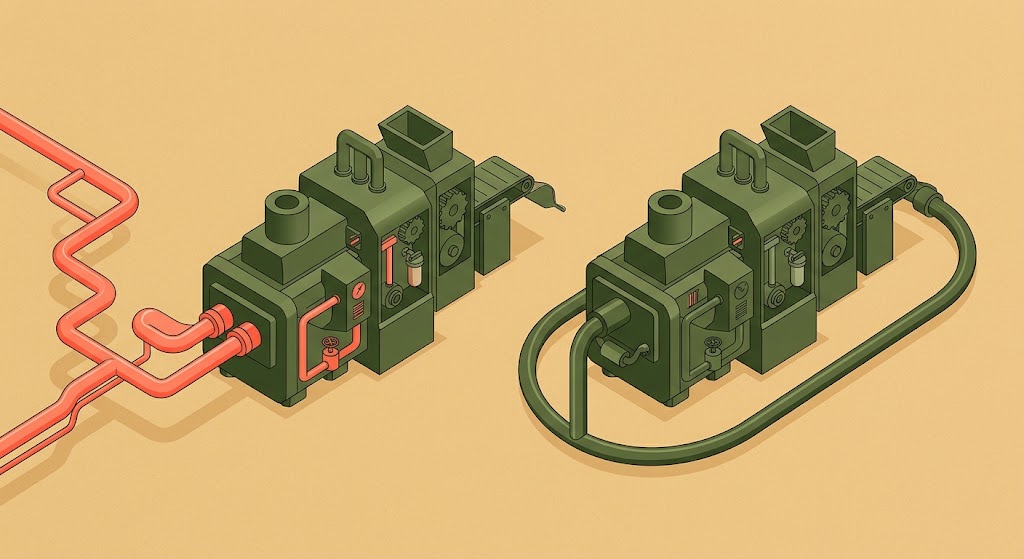
Decentralized physical infrastructure networks pay people to deploy hardware. Wireless hotspots, GPUs, storage drives, dashcams, sensors.
The pitch is that you can build infrastructure faster and cheaper by crowdsourcing it than by funding it centrally.
Whether any given network works comes down to one question, and it is not a technical one.
The Question
Does the money paying node operators come from customers outside the network or from newly issued tokens?
If it comes from customers, the network is a business with unusual funding mechanics.
If it comes from emissions, node operators are being paid in a token whose value depends on more node operators arriving. That is a distribution scheme with hardware attached.
Most networks are somewhere in between, which is the honest starting point. The useful work is figuring out where on that line a given project sits, and which direction it is moving.
How to Actually Check
Four numbers, in order of usefulness.
Revenue from external customers is the first. Not total protocol revenue, which sometimes counts tokens changing hands internally. Money from people who are not node operators.
Annual token emissions valued at current prices is the second. If emissions exceed external revenue by a wide margin, the gap is being funded by token buyers rather than by service buyers.
The ratio between those two is the single most informative figure available, and almost nobody publishes it directly.
Node operator payback period is the third. How long does hardware take to pay for itself at current reward rates? If the answer is only acceptable because of a token price assumption, that is a leveraged bet rather than an infrastructure investment.
Utilization is the fourth. Deployed hardware sitting idle is capacity, not demand. A network can grow its node count indefinitely while nobody uses it.
| Signal | Healthy | Warning |
| Revenue source | External paying customers | Mostly token emissions |
| Emissions vs revenue | Narrowing gap | Widening gap |
| Node payback | Works at current token price | Requires price appreciation |
| Utilization | Rising alongside node count | Node count rising alone |
| Enterprise share | Growing | Flat or undisclosed |
Where the Published Numbers Get Slippery
Anyone researching this sector should know the figures are unusually inconsistent, and it is worth understanding why rather than picking a source and trusting it.
Sector market capitalization has been reported at roughly $9 to $10 billion, at $15 billion, at $19.2 billion and at around $20 billion across 2025 and 2026 estimates. Those come from different project lists. There is no agreed definition of what counts as DePIN.
Bittensor is a specific example. It is frequently included in DePIN totals and is more accurately decentralized AI infrastructure. Including or excluding it moves the sector total by billions.
Project-level figures diverge too. Helium has been described as having 800,000 hotspots and 900,000 hotspots, and its subscriber base has been reported at 450,000 and at 3.5 million, which are likely measuring different products at different dates.
Render’s revenue has appeared as $38 million monthly in one source and as figures two orders of magnitude smaller in on-chain analysis of a specific period.
None of this means the sector is fictitious. It means headline numbers should be traced to a methodology before being used, and comparisons across sources are usually invalid.
The Metrics Worth Trusting
Physical and on-chain counts are harder to inflate than dollar figures.
Active hardware units, measured on-chain, are verifiable. So is GPU utilization where a network publishes it. So is the share of revenue coming from enterprise clients where it is disclosed.
One useful framing that has emerged: the share of revenue from enterprise customers rather than from token-holding participants. A network moving that ratio upward over time is converting from subsidy to business.
Optimisus has covered infrastructure in this category, including Filecoin’s onchain cloud launch.
The Risks Specific to This Sector
Hardware cost recovery is the one that hits individuals hardest. Some projects have promoted returns that assumed token prices which did not hold, leaving operators with equipment that will not pay for itself.
Regulatory fragmentation is structural. These networks are global by design and the laws are national. A wireless network operating across jurisdictions inherits telecoms regulation in each of them.
That is not theoretical. The SEC sued Helium’s creator Nova Labs, which Optimisus covered in the piece on that case.
Emissions schedules are the third. Rewards that decline on a fixed schedule create a race between falling subsidy and rising demand. If demand does not arrive first, node operators leave.
The Sector’s Actual Test
DePIN is now old enough to be judged on results rather than promise. The earliest networks have been running for more than five years.
That makes it one of the few crypto categories where the emissions-versus-revenue question can be answered with several years of data rather than a projection.
The framing that matters is simple. If token rewards exceed real revenue, the network inflates and operators eventually churn. If rewards fall before demand arrives, nodes leave first.
Threading that gap is the entire business. Everything else in a DePIN pitch is downstream of it.
For the supply-side mechanics that govern how those emissions arrive, see our explainer on token unlocks and vesting.
Sources
- Altrady, DePIN explained, a 2026 guide for crypto traders — https://www.altrady.com/blog/cryptocurrency/depin-explained-crypto-traders-guide
- BlockEden, DePIN March 2026 reality check, 650 projects, $19B market cap, revenue — https://blockeden.xyz/blog/2026/03/21/depin-march-2026-reality-check-650-projects-19b-market-cap-revenue/
- VaaSBlock, DePIN in 2026, what is actually working and what is not — https://www.vaasblock.com/news/depin-decentralized-physical-infrastructure-helium-io-net-2026/
- Titan Network, Best DePIN projects 2026 — https://www.titannet.io/learn/basics/best-depin-projects-2026-top-decentralized-physical-infrastructure-networks
- Step Data, DePIN on Solana, a data-driven analysis of revenue, contributors and rewards — https://stepdata.substack.com/p/depin-on-solana-a-data-driven-analysis
- KuCoin, DePIN crypto sector 2026 — https://www.kucoin.com/blog/en-depin-crypto-sector-2026-how-decentralized-physical-infrastructure-surpassed-oracles
This is not financial advice.
Optimisus covers crypto and technology news for readers who want the detail behind the headline.