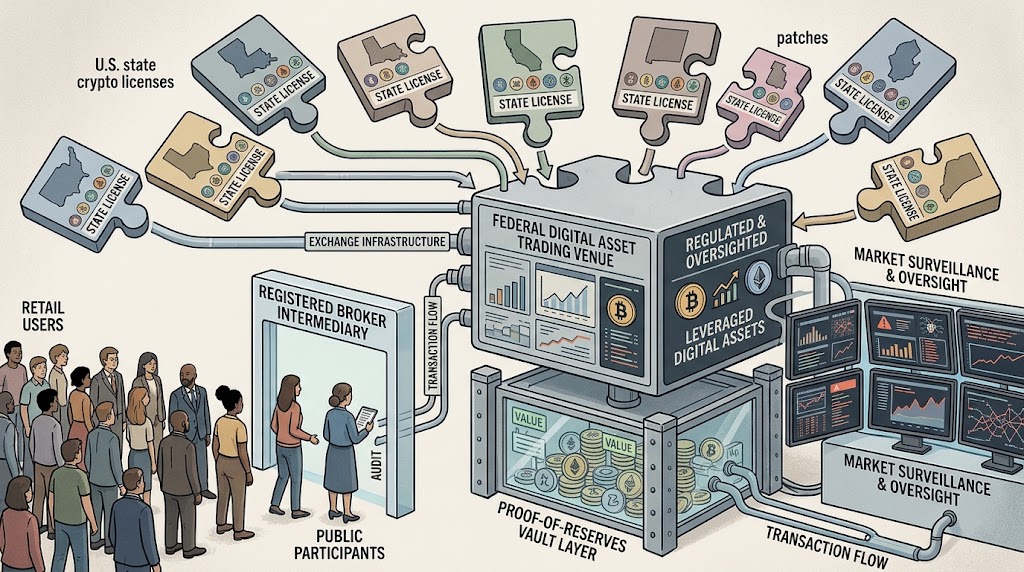
Congress failed to deliver a comprehensive U.S. crypto market-structure law. The Commodity Futures Trading Commission is now testing how far it can go with the authority it already has.
On October 5, the CFTC published an Advanced Notice of Proposed Rulemaking focused on leveraged and margined retail crypto transactions under Section 2(c)(2)(D) of the Commodity Exchange Act. The agency says it intends to build a fit-for-purpose framework for those transactions and is considering a new subcategory of designated contract market registration called a “crypto asset market.”
Reuters reports that the concept could give U.S. venues offering leveraged or margined retail crypto an optional federal framework instead of forcing them to rely primarily on a patchwork of state money-transmitter regimes.
That is significant. It is also narrower than the headline suggests.
The Authority Is About Leveraged Retail Commodity Transactions
The CFTC did not suddenly receive general jurisdiction over every spot crypto trade in the United States.
The agency is building from an existing part of the Commodity Exchange Act that covers certain retail commodity transactions involving leverage, margin or financing. Crypto fits into that framework when the transaction meets the statutory conditions.
That distinction matters because Congress was debating something much larger. The CLARITY Act attempted to create a statutory division of responsibility across digital-asset markets, including broad authority for digital commodities. Optimisus followed that process when the Senate was still trying to resolve market-structure rules, stablecoin rewards and DeFi treatment.
The new CFTC process is what an agency can attempt under existing law after that broader legislative route stalled. It is not a substitute statute hiding inside a rulebook.
A ‘Crypto Asset Market’ Would Pull Exchange Rules Into a National Framework
The CFTC says it is considering a crypto-specific subcategory of designated contract market registration. Reuters describes the proposed venue as a federal option for exchanges offering leveraged or margined retail crypto transactions.
That matters because state-by-state licensing is built mainly around money transmission and consumer protection. A federal trading-venue framework can regulate market conduct itself: surveillance, manipulation controls, customer intermediation, reserves and trading practices.
Reuters reports that the CFTC is considering anti-manipulation requirements and proof-of-reserves obligations, with registered futures commission merchants intermediating customer activity.
For a market that spent years treating proof of reserves as a voluntary trust signal after exchange failures, turning it into a regulatory condition would be a meaningful shift.
The Proposal Does Not Set a Universal Leverage Limit
Another detail is easy to miss. Reuters reports that the framework does not simply impose one leverage ratio across every covered crypto asset.
Instead, leveraged transactions would require CFTC staff clearance. That pushes the regulator toward product-level risk judgment rather than a single headline number.
The tradeoff is obvious. A flexible framework can account for differences in volatility, liquidity and market depth. It can also make the approval process less predictable if standards are not clearly defined.
That is why the comment process matters. The CFTC is at an Advanced Notice of Proposed Rulemaking stage. It is asking the market how the eventual rules should work; it has not adopted them.
The Agency Is Building Around Infrastructure It Already Regulates
The timing also lines up with the regulated derivatives stack that crypto firms are assembling.
Optimisus recently covered how Coinbase obtained its own CFTC-registered clearinghouse, completing a broker, exchange and clearing stack. A federal crypto-asset-market category would give that type of infrastructure a clearer place to connect to retail leveraged trading.
The direction is increasingly recognizable: crypto-native trading behavior is being pulled into familiar regulatory roles rather than regulators pretending the products do not exist.
Congress Still Determines the Ceiling
Agency rulemaking can be powerful. It is not the same thing as legislation.
Without a new statute, the CFTC has to stay inside authority Congress already gave it. That makes the final rules more exposed to litigation over whether the agency crossed the line, and more exposed to a future commission changing direction.
A market-structure law can settle those jurisdictional questions in a more durable way. An agency framework can improve the position while Congress remains stuck, but it cannot create unlimited authority by definition.
The useful way to read the October 5 action is therefore not “the CFTC now regulates spot crypto.” It does not.
The more interesting development is that the regulator is trying to convert a narrow but existing statutory hook into a national market framework for the part of crypto trading that most clearly resembles a derivatives market.
If the final rules survive, that may be enough to move a meaningful amount of leveraged retail activity into federally supervised infrastructure even before Congress finishes the larger job.
This is not financial advice.
Sources
- CFTC — Advanced Notice of Proposed Rulemaking on crypto asset transactions — Primary announcement dated October 5, 2026.
- Reuters — U.S. commodities regulator proposes new federal crypto oversight rules — Independent reporting on the venue category, proof-of-reserves concept and legal context.