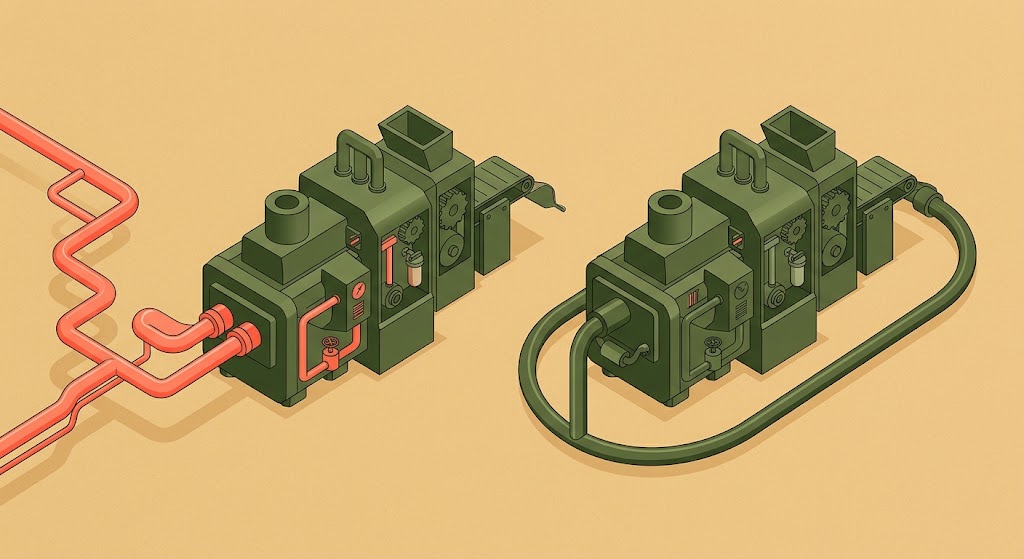
Staking is supposed to involve a trade. You commit your coins to securing the network, and in exchange for the yield, you give up access to them.
Liquid staking breaks that trade. You get the yield and you keep something tradeable. That sounds like a free lunch, and it is not.
Here is what is actually happening, and where the catch sits.
What a Liquid Staking Token Is
When you stake ETH through a liquid staking protocol, the protocol runs the validators. Your ETH goes into the deposit contract like anyone else’s.
What you get back is a receipt token. On Lido that token is stETH. On Rocket Pool it is rETH. On Coinbase it is cbETH.
The receipt is a claim on your staked position plus the rewards accruing to it. That claim is a normal ERC-20 token, so it can be sent, sold, or used as collateral.
The underlying ETH is still locked. You are trading the claim, not the coins.
Why Anyone Bothered Inventing This
Solo staking on Ethereum requires 32 ETH and a machine that stays online. Both are real barriers.
The bigger barrier was time. Withdrawals were not enabled at all until the Shapella upgrade in 2023, so early stakers had no exit at any price.
Liquid staking solved the exit problem before the protocol did. If you needed your capital back, you sold the receipt to someone else on the open market.
That secondary market is the entire innovation. Everything else follows from it.
Where the Yield Comes From
Validators earn from two sources. Consensus-layer issuance is the protocol paying for security. Execution-layer rewards are transaction tips and MEV.
The protocol takes a cut, usually around 10% of rewards, then passes the rest to the token holders. So an LST always yields slightly less than running your own validator.
You are paying that spread for convenience, for skipping the 32 ETH minimum, and for the liquidity.
Base consensus yield has compressed as staking participation has grown. Around 41.4 million ETH was staked as of early August 2026, roughly 34% of supply, and Optimisus covered what that record participation is doing to rewards in the piece on Ethereum’s staking ceiling debate.
Two Designs You Will Encounter
Rebasing tokens change your balance. Hold stETH and the number in your wallet grows daily as rewards accrue. The price stays near 1:1 with ETH.
Reward-bearing tokens keep your balance fixed and change the price instead. One rETH slowly becomes worth more than one ETH.
The distinction matters for two practical reasons. Some DeFi protocols cannot handle a balance that changes on its own. And tax treatment can differ between a growing balance and a rising price.
| Design | Balance | Price vs ETH | Example |
| Rebasing | Grows daily | Stays near 1:1 | stETH |
| Reward-bearing | Fixed | Rises over time | rETH, cbETH |
| Wrapped rebasing | Fixed | Rises over time | wstETH |
The Peg Is Not a Peg
This is the misunderstanding that costs people money.
An LST is not a stablecoin. Nothing guarantees stETH trades at exactly one ETH. It is backed one-for-one, but backing and market price are different things.
When a lot of holders want out at once, the market price of the receipt can fall below the value of the ETH behind it. That gap is a discount, not a default.
It happened in mid-2022, when stETH traded meaningfully below ETH during a wave of forced selling. The backing was intact the whole time. The exit liquidity was not.
Withdrawals now exist, which caps how wide that gap should get. But redemption takes time, and a queue that runs weeks is enough to open a discount.
The Risks Nobody Puts in the Marketing
Smart contract risk is the obvious one. Your ETH sits behind code, and code can have bugs.
Slashing risk is real but small. If the protocol’s validators misbehave or go offline badly, penalties come out of the pool, and holders absorb them.
Leverage risk is where most losses actually happen. Traders deposit stETH, borrow ETH against it, buy more stETH, and repeat. A modest discount then triggers cascading liquidations.
Centralization risk is structural. Lido’s own reporting put its share of all staked ETH around 24% in early 2026. Within the narrower liquid staking category, tracked data in May 2026 put it close to half.
Those two numbers measure different things and both get quoted as market share. Always check the denominator before repeating one.
Restaking Adds Another Layer
Restaking lets you take an LST and commit it again to secure additional services, receiving a liquid restaking token in return.
You earn a second yield. You also stack a second set of slashing conditions and a second set of smart contracts on top of the first.
That is not automatically bad. It is a compounding risk that is easy to lose track of, because each wrapper looks simple in isolation.
If you cannot name every layer between your token and the underlying ETH, you are holding more risk than you think.
Who This Is Actually For
If you hold ETH long term, want yield, and have less than 32 ETH, liquid staking is the straightforward option.
If you want the yield with no protocol layer, solo staking or a plain staking service gives you fewer moving parts and slightly more return.
If you are borrowing against your LST, you are no longer a staker. You are running a leveraged trade, and the risks in our guide to crypto trading risk apply to you more than the staking risks do.
New to how any of this fits together? Start with Ethereum explained in simple terms, then read what Ethereum 2.0 actually changed for the proof-of-stake transition that made staking possible.
The One-Line Version
A liquid staking token is a tradeable IOU for locked ETH plus its rewards. The IOU is fully backed and usually trades near par.
It can trade below par when everyone heads for the exit at once, and that is the moment leverage turns a discount into a liquidation.
Sources
- Ethereum Foundation, staking documentation and withdrawal mechanics — https://ethereum.org/en/staking/
- AMBCrypto, Lido revenue down 40% with market share intact, March 2026 — https://ambcrypto.com/lido-revenue-down-40-market-share-intact-new-report-highlights-mixed-signals/
- Crypto Adventure, Lido controls nearly half of liquid staking TVL, May 2026 — https://cryptoadventure.com/lido-controls-nearly-half-of-liquid-staking-tvl-as-ethereum-staking-debate-returns/
- Coinpedia Research, Ethereum staking hits 34% of supply and validator rewards at a three-year low, August 2026 — https://coinpedia.org/research-report/ethereum-staking-hits-34-of-supply-why-validator-rewards-are-at-a-3-year-low/
- The Block, SharpLink CEO on liquid staking tokens as DeFi collateral, August 7, 2026 — https://www.theblock.co/news/defi/2026-08-07-sharplink-ceo-warns-eip-8363-could-kill-eths-biggest-advantage-over-bitcoin-411186
This is not financial advice.
Optimisus covers crypto and technology news for readers who want the detail behind the headline.